
The Bharat Yatra: A Journey of Connection and Commitment
 Article : Sudhindra Bhadoria, Permanent Founder
Trustee, Bharat Yatra Trust
Article : Sudhindra Bhadoria, Permanent Founder
Trustee, Bharat Yatra Trust
 Photo series by : Sridhara Tumari
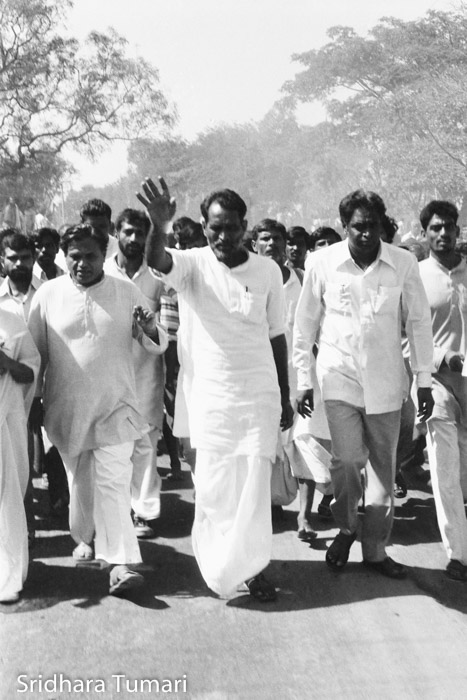
The six-month-long Pada Yatra undertaken by our former Prime Minister, Shri Chandra Shekharji, from Kanyakumari to New Delhi, has become an integral part of India’s political history. At the commencement of the Yatra, veteran socialist leader Shri S. M. Joshi from Maharashtra came to bless the journey.
Times have changed since then, and with them, the values and principles of our society and nation have undergone a sea change. Today, it is unimaginable for most to comprehend the painstaking struggles that Chandra Shekharji and the Padayatris endured during this long and arduous march. Sridhara Tumari has meaningfully documented the photographs of this Pada Yatra, covering and explaining, through vivid imagery, the purpose and significance of this unique national effort.
Chandra Shekharji, a true socialist, deeply understood the value of human connection. He believed that the only genuine way to understand the pain and problems of the people was to engage with them directly at the grassroots level. There is no substitute for a humane, physical connection. Hence, he set out on the Pada Yatra to understand his fellow countrymen, listen to their challenges, and strive to change the system in favor of the poor, the disadvantaged, and the marginalized. The issue of water became a central theme of his concern during the Yatra, as he spoke extensively about realizing the unfulfilled dreams of India’s freedom struggle.
I had maintained close contact with Chandra Shekharji from my younger days and believed that the Pada Yatra was an innovative and powerful way to connect with people. As part of the planning process, Chandra Shekharji had sent senior leaders of the Janata Party to study whether a Pada Yatra was still a relevant and feasible form of public engagement. Most of them advised him to drop the idea, saying it was not practical for leaders who aspired for power. However, he was not satisfied with this reasoning and asked me to revisit the states to gather people’s opinions firsthand.
As I understood his intent and vision for the Pada Yatra, I saw immense enthusiasm among the people. They welcomed the idea wholeheartedly, seeing it as a noble and people-centered initiative. After visiting various regions and collecting public opinion, I prepared a detailed report and presented it to Chandra Shekharji. He was overjoyed and immediately decided to move forward with the Pada Yatra—a venture that seemed almost like an adventure at the time, as it required walking over 25 kilometers every day. He approved the plan, fixed the date, and entrusted me with organizing the logistics and managing the Yatra. It was a great responsibility for someone as young and inexperienced as I was then.
When we began the Pada Yatra from Kanyakumari, the Janata Party had just won the elections in Karnataka and was in the process of forming a government. Yet, Chandra Shekharji did not abandon the Yatra for power. He commenced it as scheduled, on 6th January 1983, proving his genuine intent to connect with people rather than remain confined to the corridors of power.
As soon as Chandra Shekharji and the Padayatris entered Karnataka, Shri Ramakrishna Hegde, along with the entire state cabinet and leaders of the Janata Party and other political groups, welcomed him warmly with flowers and bouquets. Leaders such as H. D. Deve Gowda, S. R. Bommai, M. Raghupathi, and Abdul Nazeer were among those who received him at various stages. The handbook Vichara Yatrika, authored by Khadri Shamanna, beautifully reflected the concept and philosophy behind Chandra Shekharji’s Bharat Yatra.
When the Pada Yatra reached Anekal, the local Congress leader and Taluk Congress President, Shamanna, invited Chandra Shekharji to his home and hosted him with warm hospitality. The entire town celebrated the visit as though it were a festival. When reporters questioned whether it was appropriate for a Congress leader to welcome him, Shamanna replied that Chandra Shekharji’s Bharat Yatra was for the welfare of the nation, not for any political party, and therefore, everyone should support it.
At Chitradurga, the veteran freedom fighter and former Chief Minister of Karnataka, Shri S. Nijalingappa, welcomed us in his village with great warmth and respect.
Among the senior leaders accompanying the Yatra were Bhai Vaidya and Beni Prasad Madhav, who provided constant guidance and support throughout the journey. Along the way, countless citizens joined in, contributing generously to meet the expenses of the Yatra. Their enthusiasm further energized Chandra Shekharji and the Padayatris during this long and demanding journey.
The impact of the Pada Yatra was soon evident in Karnataka’s governance. The Janata Party government prioritized drinking water as a key issue and implemented decentralization of power through the revolutionary Panchayati Raj Bill. As a result, Chandra Shekharji’s Bharat Yatra gained immense popularity in Karnataka and across India.
Towards the end of the journey, as we marched from Humayun’s Tomb, renowned BBC journalist Mark Tully conducted a detailed interview with Chandra Shekharji. When the Pada Yatra finally reached Gandhi Samadhi, a sea of people walked alongside him. There, a pledge was taken to continue the spirit of the Bharat Yatra and uphold the principles cherished during the freedom struggle.
The Padayatris committed themselves to a five-point social action program focusing on:
- Drinking water
- Nutritional food
- Primary education
- Dignity and equality for Scheduled Castes and Scheduled Tribes
- Communal harmony
By the end of the Pada Yatra, we had become like one family. Each Padayatri departed with a heavy heart and tears in their eyes. Chandra Shekharji had shown us a new path and a new vision for India. Now, it is upon the new generation to carry forward this spirit of selflessness and service.
To conclude, I am reminded of his words, which he often repeated, even in his final days:
“The Bharat Yatra was the highest point of my life. It was this journey to the masses — to understand reality from the bottom up — that gave me the true meaning and purpose of life.”
Indeed, the Bharat Yatra remains a timeless testament to Chandra Shekharji’s belief in the power of human connection and the soul of India.